AI: “Not Hiding the Machine, but Learning How to Speak Through It”

This is now a different argument. Previously you said you wouldn’t put your name to AI content because students oughtn’t. Now you’re saying you do use it, but believe the best way to do it is with a human in the driving seat, so to speak.

On this new point, I don’t think you would find many people to disagree. AIs are poor at devising structure. Not just in the final prose, but in the process of creation. When we train staff to use AI to create long form content, we have a 7 stage process that we encourage people to walk the AI through, because we find this gives vastly better results. An AI will not yet do this level of depth of its own volition. So on this I agree, but this isn’t really to do with the earlier discussion.

That’s not quite accurate. In my original post, I said, “Rather than using AI to do the writing for me, I prefer to use it to help shape the outline, structure, and direction of the work, while I supply the words and arguments myself.” I later added the concern about the importance of modeling integrity for our students.

My central concerns remain: authenticity and integrity, and the potential diminishment of writing ability, creativity, and imaginative thinking when we outsource the writing process to AI.

Let me put it as plainly as I can: If I pay someone $20 a month to write my papers, then I revise those papers, put my name on them, and submit them, isn’t that essentially the same as paying someone to do my homework? And isn’t that what we’re doing if we use AI to write the content for us—rather than limiting its use to ideation, structural guidance, or editing? That’s the crux of the issue for me.

Let me also reiterate that I’m not trying to argue. I’m genuinely enjoying and profiting from the dialogue. It’s helping me process, shape, and sharpen my thinking on this issue.

I’d love to hear more about your seven-stage process—that sounds intriguing and potentially very helpful.

Would you be willing to share it?

2 Likes

Oh heavens—not even in the ballpark. But I appreciate the kind words. The objective fact is that I’m an average writer at best. I’ve simply had to do a lot of writing throughout my life (and I read a lot)! :slightly_smiling_face::sweat_smile:

I completely agree with this:

The prompt I used for this piece, for instance, was: ‘I recorded this blog post using a speech recognition AI, so it rambles around a bit and is full of transcription errors and artifacts. Can you clean it up while keeping as close to my intended tone and content as possible?’ It’s not generative writing. It’s not even close.

Unless I’m misunderstanding him, this is essentially the same process I’m following—though I’ve not yet made a habit of using dictation.

You may be costing me. :slightly_smiling_face: I usually avoid subscriptions like the plague, but I’m going to check out Whisper Pro. If I end up subscribing, I just want you to know—it’s entirely your fault. :rofl:

Suppose you are creating a new policy in your school. You explain the details to your administrative assistance and ask him/her to draft an announcement for the school community. Then you add, delete and edit content in the first draft. You go through several iterations of that. Your assistant does a spelling and grammar check and then you give it a final OK.

Is it OK for your name alone to be listed as the author of the document? Yes

If the document is a big success may you take the credit? Yes.

If the documnent is a big fail due to some major error or omission - either gramatically or conceptually- who takes the blame? You alone.

Anything wrong with that?

Why is AI any different?

I’m a little confused. What is the correct link for Whisper Pro (I’m running into different “whisper apps”).

Sorry for my confusion, but when I clicked on the link and the article, it takes me to this site: 🎙️ MacWhisper

Am I confusing this with another Whisper service I’ve heard @MacSparky mention?

I want to give this additional thought before responding because you bring up an intriguing analogy.

Just to clarify—are you suggesting it’s appropriate to prompt AI to write an entire report, with only two inputs from the user:
1. the original prompt(s), and
2. post-generation editing?

If that’s the case, wouldn’t AI, in effect, be functioning as a ghostwriter? And if so, are we comfortable saying that it’s now standard practice to rely on an AI ghostwriter rather than composing the work ourselves?

This brings us full circle then as we’re back to my first point - the only reason anyone would look down on you using AI is because of your corporate culture, which presumably puts more value on how work was created rather how good the end product is. As I said before, the end product is more highly valued at my company than the process used to create it.

Our 7 stage process is Prepare, Research, Compose, Outline, Fill, Review, Critique.

So, for example, last week I did a proposal around tackling TB in a city in the UK.

I started by pulling together a bunch of public health reports I had on file, some strategy documents by local government, some reports that my company had created on similar work and a few other bits and pieces, and put them in the Claude Projects folder.

Then I created a research document to act as a base. I walked the AI through analysing the papers above, asking it to find gaps in the evidence and then do web searches for missing info. I check the content for credibility as I go and manually ask it to remove citations I don’t like, then eventually get it to create what is essentially a fact sheet that is used to support the rest of the process. (Pastebin link to it here) I then use prompts shaped to only use information in this document, which more or less eliminates hallucinations.

Then I told the AI the composition I want, the order of things, etc. Also what not to include.

Then I asked it to create the paper in outline. I check the outline, make changes, then ask it to fill in the narrative, specifying things like tone, grammar, word count and audience.

I did a manual review at this point, reading it in its entirety and making any manual changes I want. I don’t remember how much I changed, but usually 30 or 40 things.

Then I go through a structured critique, asking it analyse its own work from various angles, like factual accuracy, how compelling it seems, whether it uses plain English, whether the proposed work is plausible, and so on. The more important the work, the longer the critique. We all use a snippet manager with a shared set of AI prompts that includes critiques.

We obviously don’t use every single step for shorter pieces of work, but for any long form content like proposals, reports, research, press releases, etc we encourage staff to run through this process.

This is also why we use the phrase Guided Creation. We’re walking the AI through the process and using our expertise at every step to keep the quality high. So its less like asking someone to do your homework, more like telling a team of builders how to build a house for you, section by section. You’re not lifting bricks, you’re coordinating their work.

1 Like

I believe it is perfectly acceptable to use an editor without attribution. That is different from a ghostwriter.

Of course there is overlap between the two. I think the key difference is that with an editor, full responsibility and credit for the tone and intellectual content remains with the author; the editor need not even be credited. A ghostwriter may contirbute so many original ideas and so many ideas unverified by the main author such that the ghostwriter qualifies as a coauthor either legally or morally.

Most importantly - I am not suggesting it is acceptable to prompt AI to write an entire report with “Just an original prompt.” That prompt should be detailed and nuanced and it should include examples of the author’s prior work and tone.

“ChatGPT - write me a paper on the causes of the US Civil War” is not acceptable.

Much more acceptable would be to give ChatGPT some examples of your prior papers for style and then to wrtie a very deteailed prompt such as “Explore the causes of the civil war from economic, social, racial, and political perspecties. Cite exact quotes from past authors A, B, C, D, E and others which argue that the Civl War was or was not about slavery. Create a timeline of quotes contrasting views on these topics as they have changed through the war, through Reconstruction, through Jim Crow, through the Civl Rights era, and beyond. Consider how these concepts shape current political events as well as how current political events shape public perspectives of history. Include active hyperlinks to the source of all facts and attributions.”

In my view that is Step 1. Then Step 2 is for the student to read every single soruce that ChatGPT provides in order to accept /edit/delete its interpretation. Then Step 3 is for the student to add or edit additional content.

At that point the human author “owns” the paper.

@nfdksdfkh, @rkaplan, and @Clarke_Ching Your responses are substantive and challenging and have caused me to rethink my approach to this matter. I want to take additional time to reflect before offering a fuller reply, but I want to quickly thank you. I deeply appreciate the insights you’ve shared regarding the use of AI—they are genuinely stimulating my thinking. I’ll follow up with you a bit later.

2 Likes

This isn’t my response to the above (I’ll respond more fully later)—just something I came across. I happened to stumble on this article, and it seems pertinent.

1 Like

There are many apps that use whisper dictation, all with slightly different approaches and different UIs.

Here are 3 options -

  1. SuperWhisper is extremely good. It’s a Mac app, and and I currently have a 1 month subscription so that I can try it out without having to buy anything (always trying to save money!): https://superwhisper.com

  2. The one the author of that article, and many others, use is indeed MacWhisper: 🎙️ MacWhisper. It’s good but they only added dictation a few months ago so it’s not as clever or as solid as super whisper (at least, that’s my experience).

  3. (my favourite) If I’m doing dictation for something that’s going to require several bursts, I use the dictation built into chatgpt as well as a prompt that (a) let’s me to chat for 3-6 minutes, (b) get it transcribed by chatgpt, then (c) tidy up as I go, and finally, (d) join the bursts up once I’ve done enough. I find it too exhaustion to talk and talk and talk - and, I also want to see progress as I go along, in case something’s gone wrong. I shared more here: https://talk.macpowerusers.com/t/using-chatgpt-as-a-dictation-tool/

That last option is free because I already subscribe to ChatGPT.

Thank you—this is very helpful. I also came across Whisper Memos. With several apps using the name “Whisper,” it was becoming confusing. I appreciate the clarification.

As promised, I’m responding to your recent posts. Thank you all for your outstanding and gracious contributions. The thoughtfulness and thoroughness of your responses have not only been appreciated but have genuinely helped me wrestle with where to draw the line–and how best to use AI in professional writing. I’m also considering how we can equip students to use AI ethically and effectively, without losing our focus on helping them develop strong writing skills and sharpen their thinking through the writing process.

As I’ve said before, there is a subtle but significant distinction between using AI to support one’s writing and using it as a substitute for writing. The natural temptation–for our students, and perhaps for all of us–is to slip into the latter.

I found the Guided Creation process described by @nfdksdfkh particularly helpful. To sharpen my own thinking on this issue, I plan to write a white paper on artificial intelligence in education–specifically in Christian schools–using that process. My tentative, working title is:

Artificial Intelligence at Westminster: Advancing Innovation with Reformed Theological Conviction and Academic Excellence
A White Paper on Educational Philosophy and Practice in the Age of AI

I’ll combine the process with dictation (per @Clarke_Ching) and continue beginning with rough brainstorming using pen and paper.

In the classroom, the primary challenge may be getting students to do what @rkaplan wisely suggested: “Step 2 is for the student to read every single source that ChatGPT provides in order to accept /edit/delete its interpretation.” That’s easier said than done–and even harder to verify. :slightly_smiling_face:

Thank you again. Your time, thoughtfulness, and generosity have been both helpful and deeply appreciated. I’m sincerely grateful—and better for your wise counsel.

Hmmm … I’m a “write to think” person. I find that it’s the very grappling with how to tease out my main themes, structure my discussion, and build my argument that makes writing a tool for thinking. Perhaps I misunderstand your process, but I’d be loathe to offload it to an AI.

Where voice doesn’t matter, but straightforward simplicity does, I am very happy to let an AI prune seven pages down to three, say.

Your “Explore the causes of the Civil War …” prompt is within a hair’s breadth of the kind of essay questions I’d use for midterms or finals questions or term paper assignments when I was teaching freshman-level literature courses back in the day. We considered these courses to be as much about how to engage critically with both primary and secondary sources as about the books on the reading list.

1 Like

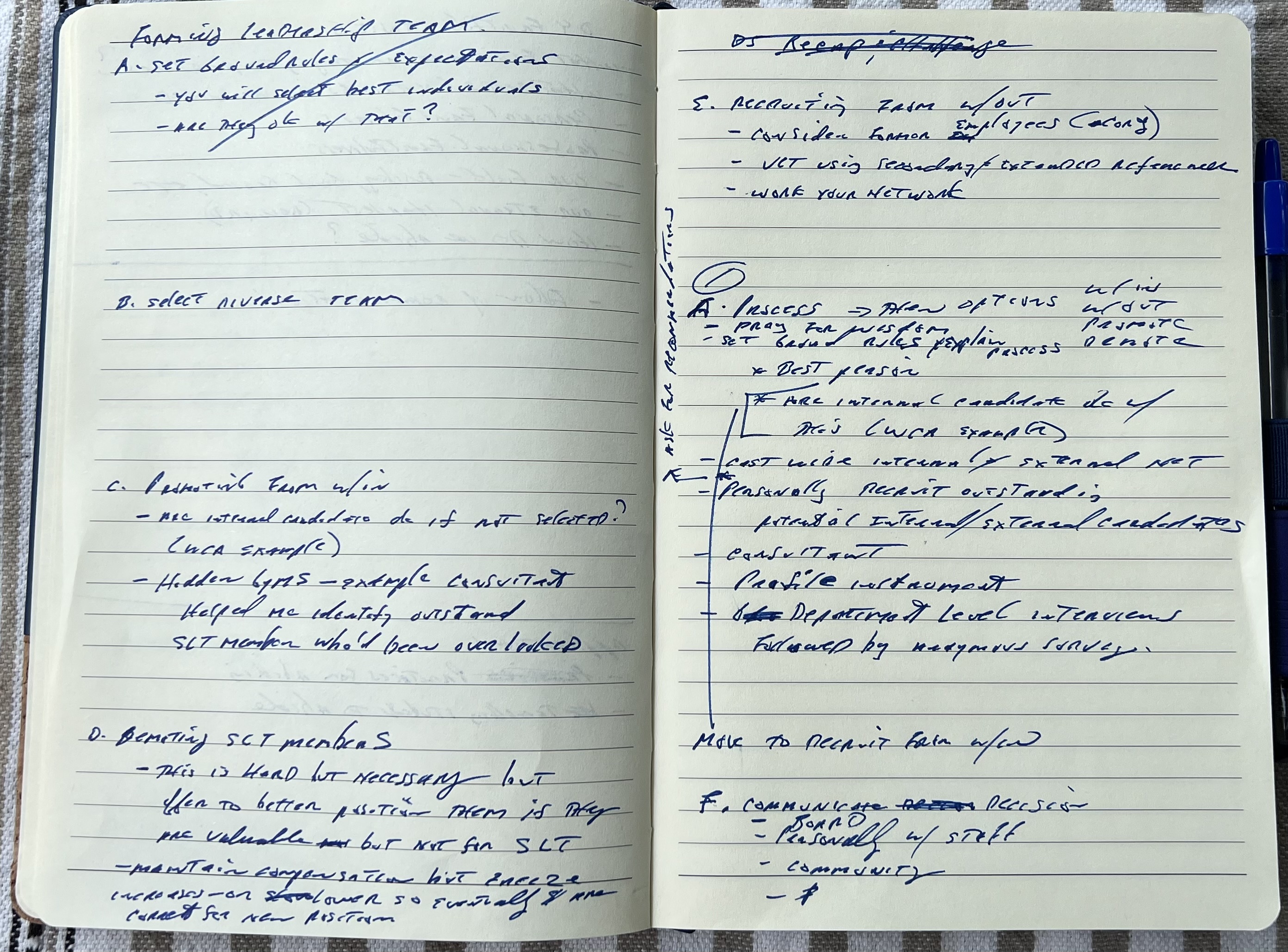
I apologize for not being clearer. As I posted in the photo above and below, I write (often with pen and paper) to flesh out my initial ideas before engaging AI for anything–including structural ideas.

I think better when I’m writing. Using pen and paper creates more work, but I think the end product is better in the long run. If I’m not using pen and paper, I’m using the Apple Pencil on the iPad in Apple Notes.

I only do this: “Rather than using AI to do the writing for me, I prefer to use it to help shape the outline, structure, and direction of the work, while I supply the words and arguments myself … That said, I see no issue with using AI to generate ideas for structure, main themes, or discussion points…” AFTER I’ve put pen to paper. :slightly_smiling_face:

1 Like