I’m running such an M1 Air with 8 GB… What’s better about the Neo?
1 Like
It will probably be supported longer than your M1 MBA.
2 Likes
The single core CPU performance is between the M3 and M4
Edit: Ignore the above, it’s obviously rubbish
3 Likes
Pretty much why I got one. I used my iPad mini for YouTube, Plex, NetNewsWire, occaionally social apps, and one or two casual games.
The YouTube and Plex experiences are slightly inferior on the Mac. Everything else is equivalent or better.
But… the one thing I often wanted to do on my iPad was a little writing. An iPad with a keyboard is a different class of device, regardless of price.
I used to own an 11” Pro with Magic Keyboard. A beautiful device for all of the above, but nearly as heavy as the Neo (1.07 kg versus 1.27 kg) and around twice the price 6 years ago. I sold that when the M1 Macs came out (I got the original 13” MacBook Pro) because the only thing the iPad soundly beat Intel Macs on was battery and Apple Silicon busted that down.
The Neo is bigger (but also has a bigger screen) and heavier but has a built-in full-sized keyboard, a built-in stand, a built in screen cover, a better gesture system (I still don’t get on with most iPad gestures), more configurability, easier multitasking… I could go on.
4 Likes
One thing your MacBook Air has over the Neo is that you already own it. I wouldn’t suggest you upgrade unless you want a Citrus case. 
6 Likes
I don’t see the Neo as an upgrade (not even for my end of life iPad!), so not planning that.
I’m curious about the rumored M6 MacBook (Pro or Ultra?) with an OLED screen at the end of the year though.
2 Likes
This is a lovely answer to the original question:
(Not the title, but the actual message in the post)
8 Likes
Excellent article. It’s opinionated in the best way.
My favourite bit…
1 Like
That is a good article. The excerpt below reminds me of constructionism in education. As many of you know, constructionism is the learning theory developed by Seymour Papert, in which he argues that learners do not simply receive knowledge passively, nor do they merely construct understanding internally; they build it by making something and when they encounter “resistance,” i.e., problems to overcome. This is why our school defines “rigor” not as more but as a means of teaching students to problem-solve and think critically. Students are asked to wrestle with complex concepts and issues independently. Independent learning is the key. As students draw conclusions and make connections across subjects, they grow confident in their ability to take increased responsibility for their learning. They internalize from their construction; they do not merely receive information passively, soon to be forgotten. They encounter, they struggle, they construct, they do, they learn, they remember.
He is going to go through System Settings, panel by panel, and adjust everything he can adjust just to see how he likes it. He is going to make a folder called “Projects” with nothing in it. He is going to download Blender because someone on Reddit said it was free, and then stare at the interface for forty-five minutes. He is going to open GarageBand and make something that is not a song. He is going to take screenshots of fonts he likes and put them in a folder called “cool fonts” and not know why. Then he is going to have Blender and GarageBand and Safari and Xcode all open at once, not because he’s working in all of them but because he doesn’t know you’re not supposed to do that, and the machine is going to get hot and slow and he is going to learn what the spinning beachball cursor means. None of this will look, from the outside, like the beginning of anything. But one of those things is going to stick longer than the others. He won’t know which one until later. He’ll just know he keeps opening it.
That is not a bug in how he’s using the computer. That is the entire mechanism by which a kid becomes a developer. Or a designer. Or a filmmaker. Or whatever it is that comes after spending thousands of hours alone in a room with a machine that was never quite right for what you were asking of it.
3 Likes
Thank you for posting this. I came here to do the same thing. What a wonderfully written post it is.
1 Like
We are in a similar situation with my wife’s laptop. She has my old M1. The Neo would be faster in single core performance, but the ports are hobbled, the SSD is slower, we aren’t exactly smashing into situations where the single core performance is a problem, and we already own the M1.
I could be wrong on this, but I would anticipate that as this family of product continues, some of current compromises may either improve or disappear.
The USB ports, for example. When Apple designed the A18, they might not have been thinking of putting it in a laptop. For future generations, if they know that a given chip is going to be dual purpose, they may add a more advanced USB controller.
1 Like
I was about to reply that it has a smaller resolution to an iPad Pro 11", which is true, but it’s as close to parity as to be not worth arguing about.
1 Like
I want the Old Yeller one even though Im a Max guy.
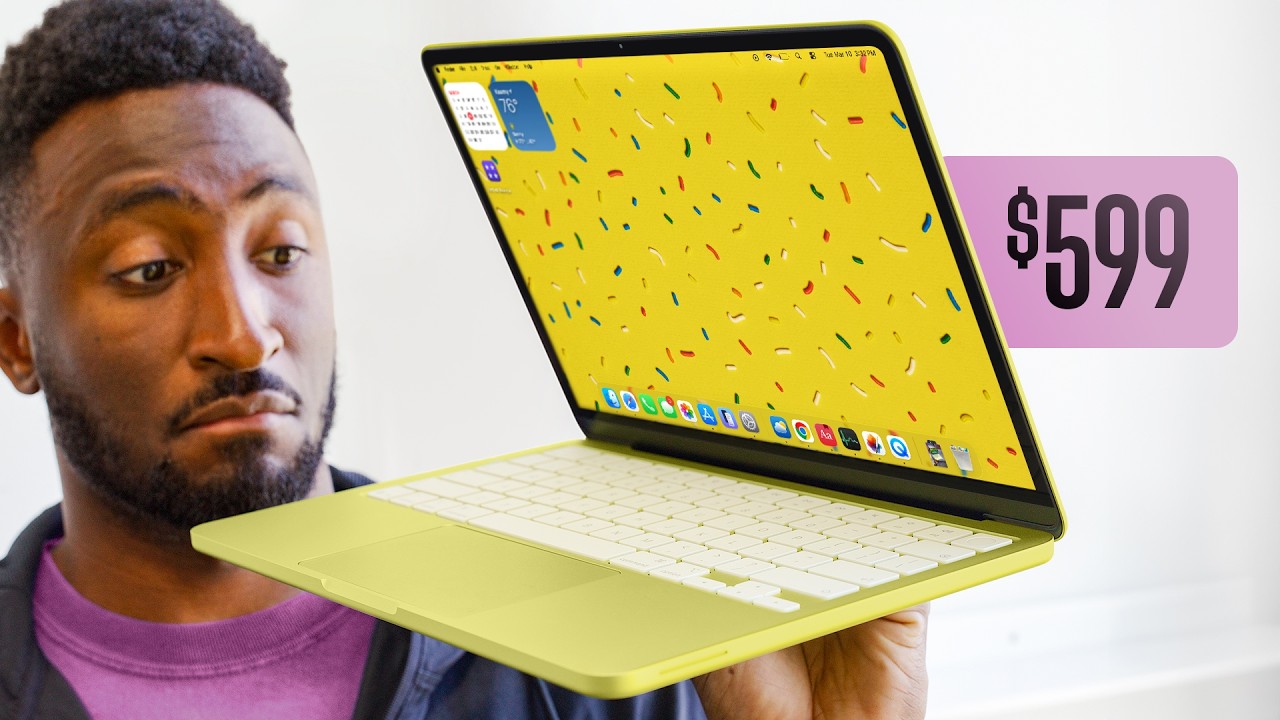
This is an excellent video on the new Mac Neo.
Marques Brownlee is one of my favorite tech Youtubers.
3 Likes
I think asking who it’s for would only take you half way there.
The real question is What is it for?
Gruber seems to think it’s for video editing, or at least citing that as a use case. Maybe some will. But I’m still unclear on what it’s for given the obvious limitations.
Like Marques pointed out in his first look (not the review) if you ask that sort of question, its probably not for you. If you frequent this forum, its probably not for you. One thing’s for sure, this thing will sell like hot cakes.
6 Likes
Right. A computer doesn’t have to be great for everybody to be great for somebody. It’s not a binary choice.
6 Likes
Update, 10 days later, I got a Neo. It’s pretty cool so far. I traded in my iPad Pro for it. Sure, I am losing Pro Motion, but I am gaining macOS. I will update further if anyone is interested in a separate thread.
8 Likes
Take every review with a grain of salt. In this case, the grain is shaped like someone who is not a photographer and therefore slightly overplayed his hand on that subject.
He said because it doesn’t have a P3 screen, it’s not as good for photographers. I don’t know about professionals (not overplaying my hand) but there is common advice out there to always export final images in sRGB because the vast, vast majority of screens in the world are sRGB. Most of them won’t be calibrated, either. In fact, an Apple sRGB screen is actually a better choice than a lot of expensive monitors out there unless you also purchase a calibration device.
Even professional photographers managed fine for decades (and many still do) with sRGB.
5 Likes
I think the jury’s out there.
The Neo is a cost-down product, and you only get that by compromising on hardware and hardware performance. I think it will take more than a few benchmarks before anyone could really recommend this to anyone to buy.